

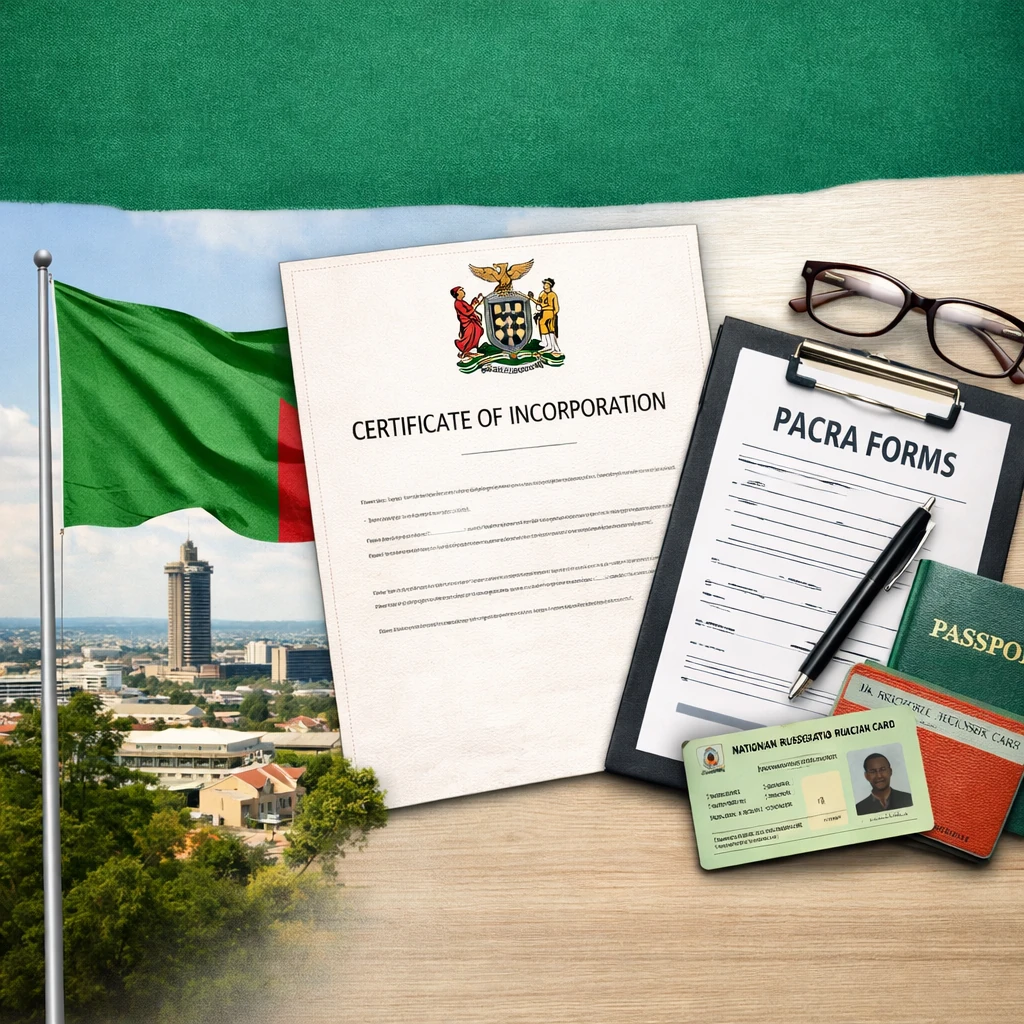
Starting a business in Zambia is easier than many people assume, but only if you understand the process from the beginning. Company registration is the first formal step that transforms your idea into a legally recognized entity, allowing you to operate, open bank accounts, and build credibility with clients and partners. The challenge for many entrepreneurs is not the complexity of the system, but knowing exactly what to prepare and when. This guide breaks down the registration process and required documents in a clear, practical way so you can move from concept to incorporation without unnecessary delays.
Step 1: Name Clearance
The first step is reserving a company name.
You submit a proposed name through PACRA for approval. The name must be unique and not similar to an existing registered entity. If approved, it is reserved for a limited period, typically 30 days.
Required information:
- Proposed company name (at least 3 options recommended)
- Nature of business activities
Step 2: Preparation of Incorporation Documents
Once the name is approved, you proceed to prepare incorporation documents. This is the most documentation-heavy stage.
Key documents required
- Form 3 – Application for Incorporation
This is the official application form submitted to PACRA. It includes:
- Company name
- Registered office address
- Details of directors and shareholders
- Share capital structure
- Articles of Association
This document defines how the company will be governed. It outlines:
- Roles of directors
- Shareholder rights
- Decision-making procedures
- Consent to Act as Director (Form 11)
Each director must formally agree to serve in the role.
- Declaration of Compliance (Form 12)
Confirms that all legal requirements for incorporation have been met.
Step 3: Supporting Identification Documents
PACRA requires identity verification for all individuals involved in the company.
You will need:
- National Registration Card (NRC) for Zambian citizens or passport for foreigners
- Tax Identification Number (TPIN) for each director and shareholder
- Proof of residential address (in some cases)
For corporate shareholders, additional documents such as a certificate of incorporation from their country of origin may be required.
Step 4: Submission and Payment
All documents are submitted through the PACRA online system.
You will also need to pay the prescribed registration fees, which vary depending on the company’s nominal share capital.
After submission, PACRA reviews the application for compliance. If everything is in order, approval is typically granted within 3 working days.
Step 5: Issuance of Certificate of Incorporation
Once approved, PACRA issues a Certificate of Incorporation. This is the legal proof that your company exists as a separate entity.
At this point, your company can:
- Enter into contracts
- Open a corporate bank account
- Begin operations
Step 6: Post-Registration Requirements
Registration does not end with incorporation. You must complete additional compliance steps:
- Register for tax with the Zambia Revenue Authority
- Obtain necessary sector-specific licenses
- Register for social security with the National Pension Scheme Authority if hiring employees
Common Pitfalls to Avoid
Several issues frequently delay registration:
- Submitting incomplete forms or inconsistent information
- Using a name that closely resembles an existing company
- Missing TPINs for directors or shareholders
- Errors in share capital allocation
Careful review of documents before submission significantly reduces rejection rates.
Final Observation
The company registration process in Zambia is largely procedural. The critical factor is not complexity but accuracy. Ensuring that all documents are correctly prepared, consistent, and complete allows for a smooth and fast incorporation process.

